

432Hz Converter with Batch Mode for PC Folders and Audio CDs
This 432Hz converter changes the tuning reference of music files to values such as 432 Hz, 528 Hz and other selectable frequencies.The batch converter for 432 Hz, 528 Hz and related frequency settings is intended for users who want to retune larger music collections without editing each track separately. It focuses on folder-based processing, selectable target values and support for common audio formats.

Using the software, music files can be adjusted to frequencies such as 432 Hz or 528 Hz. These values are often used by listeners who prefer alternative tunings for comparison tests, playlist organization or personal audio projects.
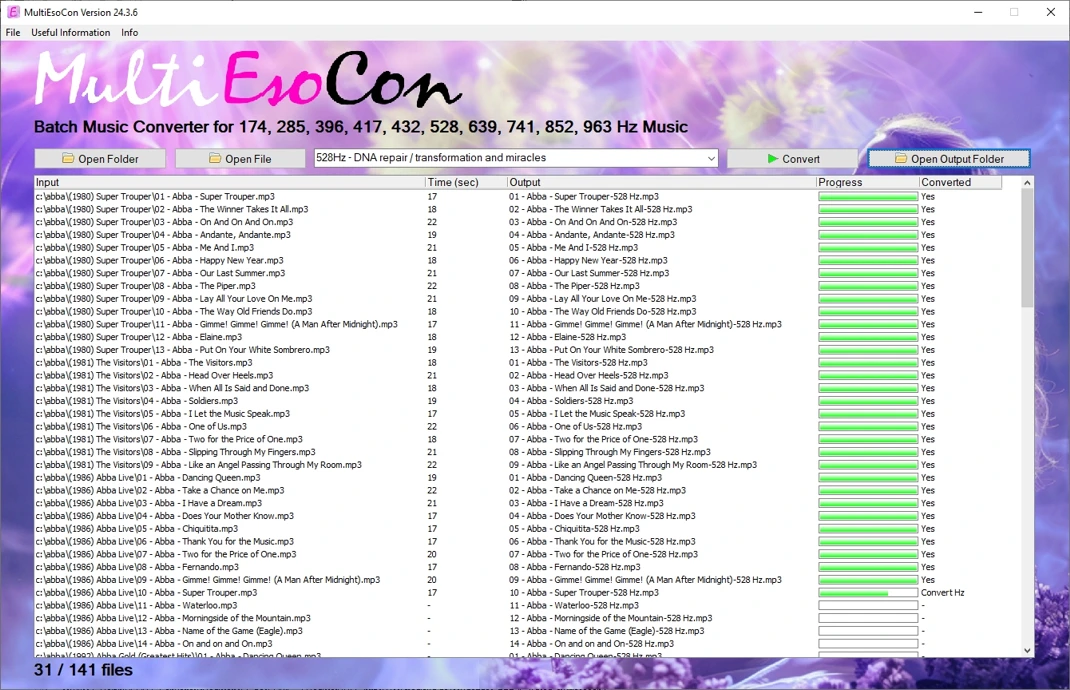 Image: 432Hz Converter
With batch conversion, large collections of music files can be processed simultaneously instead of track by track. Users select the target frequency, add files or folders, and let the program complete the conversion. Custom frequency settings are also available for precise audio tuning.
Benefits and Features of the Solfeggio Frequency Converter
- Batch processing for converting multiple files from folders or entire folder structures
- Frequency conversion of all common Solfeggio Hz numbers (528, 432, 285, 174, 417, 396, 639, 852, and 741 Hz)
- Support for major audio file formats (MP3, M4A, WAV, FLAC, AAC, AIF, AIFF)
- Clear user interface for selecting files and frequencies
- Flexibility in choosing and adjusting frequencies
- Preservation of sound quality during conversion
- Fast conversion times for large batches
- Ideal for large music collections on the PC
The "MultiEsoCon" Frequency Converter and Its Features
The MultiEsoCon converter can retune music from the conventional 440 Hz reference to 432 Hz or other selected frequency values. MultiEsoCon is a tool for adjusting audio files to alternative tuning references. The standard A4 tuning of 440 Hz is widely used in modern music production, while 432 Hz is preferred by some listeners for its softer perceived character. The software gives users a practical way to compare these tunings in their own music files.
Changing a track from 440 Hz to 432 Hz is more than renaming a frequency label. The pitch must be shifted while keeping the timing and file quality usable. The converter is therefore designed to process the audio data consistently and to preserve the structure of the original recording as far as possible during conversion.
One practical feature of MultiEsoCon is format support. The software works with MP3, WAV, M4A, AAC, FLAC, AIFF and AIF files, so users can process music from different sources. Batch conversion is useful for albums, playlists and folder structures because multiple tracks can be handled in one pass.
Users who create ambient, instrumental or comparison playlists can use the program to prepare tracks in a consistent tuning. The interface keeps the process simple: import the music, choose the frequency value and start the conversion. This makes the software useful for personal collections as well as organized audio libraries.
Overview of Frequencies and Common Associations
- 528 Hz converter - often used in Solfeggio and playlists
- 432Hz Converter - alternative tuning associated with a softer listening character
- 639 Hz converter - often linked with relationship and harmony themes in playlists
- 741 Hz converter - used in clarity and focus-oriented Solfeggio sets
- 852 Hz converter - often associated with orientation themes in Solfeggio-style music
- 396 Hz converter - used in release and reflection-themed audio collections
- 174 Hz converter - often used for steady, slow listening material
- 285 Hz converter - used in restoration-themed Solfeggio playlists
- 417 Hz converter - often linked with change and renewal themes
- 963 Hz converter - used in upper-range and attention-themed playlists
History and Origins of Frequency-Based Music Practices:
Sound and music have long been used in cultural, ritual and listening settings.The history of sound-based practices reaches back to early civilizations, where music was used in ceremonies, storytelling, communal rituals and organized listening. Different cultures developed their own instruments, scales and listening traditions for social, cultural and artistic purposes.
In ancient Greece, music was closely connected with mathematics, philosophy and music theory. Pythagoras and later thinkers examined intervals, ratios and harmony as part of a broader attempt to understand order in music and nature.
Music also had cultural importance in ancient Egypt. Instruments, chants and architectural spaces were used to create sound experiences in temples and cultural contexts. For anyone who wants to explore alternative sources of information and tips about 432Hz converter, this website provides additional practical content. These historical examples show how strongly music was tied to culture and symbolism.
In India, ragas developed as melodic frameworks connected with time of day, season and mood. They were not limited to entertainment; they also shaped devotional, listening and classical music traditions.
In China, music theory was linked with ideas such as Qi, the five elements and Yin and Yang. These concepts formed part of a broader cultural understanding of order, balance and organized sound.
Over time, many of these traditions influenced modern listening practices. Today, sound, tuning and frequency are discussed in music production, playlist culture and academic music studies, depending on the context.
This history shows that people have long connected music with atmosphere, listening habits, attention and preference. Modern frequency tools continue that interest from a technical angle: they let users experiment with tuning values in existing recordings.
What Do Solfeggio Frequency Labels Mean?
- 528 Hz converter – Common Solfeggio Label: This frequency is often described in playlists and esoteric music contexts as the "Miracle Tone" or "Frequency of Love" in naming schemes.
- 432Hz Converter – Alternative Tuning Reference: This frequency is often presented as a softer-sounding tuning option for music, ambient tracks and instrumental audio.
- 639 Hz converter – Relationship Label: This frequency is commonly used in playlists that focus on connection, communication and harmony labels.
- 417 Hz converter – Change Label: This frequency is often used in audio collections labelled for transition, renewal or reflection labels.
- 963 Hz converter – Upper-Range Label: This frequency is commonly used in Solfeggio and ambient playlists.
- 396 Hz converter – Release Label: This frequency is often used in music labelled for release, reflection and reset labels.
- 174 Hz converter – Low-Frequency Label: This frequency is commonly used in slow or quiet audio material.
- 852 Hz converter – Orientation Label: This frequency is often used in music labelled for focus and orientation labels.
- 285 Hz converter – Restoration Label: This frequency is used in Solfeggio-style playlists with restoration or renewal labels.
- 741 Hz converter – Clarity Label: This frequency is commonly used in playlists labelled for clarity, order or expression labelss.
Table of Solfeggio Music Features
| Frequency (Hz) | Association | Features |
|---|---|---|
| 396 Hz Converter | Release and Reflection | Used in playlists that focus on release labels and personal reflection. |
| 417 Hz Converter | Change and Renewal | Often used for music labelled with transition or renewal themes. |
| 432Hz Converter | Alternative Harmony | Commonly presented as a softer alternative to standard tuning. |
| 528 Hz Converter | Love and Warmth | Often labelled as the "Frequency of Love" in Solfeggio music collections. |
| 639 Hz Converter | Harmony in Relationships | Used for playlists centred on connection and communication. |
| 741 Hz Converter | Clarity and Expression | Often used in audio collections labelled for clarity or focused listening. |
432Hz Converter and 528 Hz Music - Significance and Use
The 432 Hz and 528 Hz settings are popular in ambient, instrumental and Solfeggio-style music collections.432 Hz music and 528 Hz music created with this converter are two alternative tuning choices used in sound design and frequency-based music contexts. Some listeners describe 432 Hz as softer or more grounded than standard tuning. 528 Hz is frequently labelled as the "Frequency of Love" in Solfeggio playlists and is used for tracks with a warm, contemplative character.
 Image: 528 Hz converter
New Tool - 432Hz Converter
A newer 432Hz Converter is ready to use and makes the audio conversion process more straightforward. 528 Hz music is commonly associated with love, warmth and transformation themes in Solfeggio playlists. The converter helps users prepare tracks in this tuning without manually editing each file.In practice, both frequencies are used for ambient playlists, background music, instrumental collections, sound baths and personal listening. 432 Hz is also used by musicians who prefer a slightly lower A4 reference than 440 Hz. 432Hz converter, we are pleased to inform you that it is now available on eBay, with familiar payment options and international ordering options for users who prefer buying through that marketplace.
528 Hz music is often used in guided recordings, ambient tracks and Solfeggio audio collections. In this context, the converter is mainly a technical tool: it retunes existing recordings so that users can build a consistent library around the selected frequency.
Both frequency values have a strong presence in alternative tuning culture. The software makes experimentation easier by allowing users to compare versions, organize converted files and create playlists with a consistent tuning reference.
The Esoteric Significance of Solfeggio Frequencies:
- Energetic Cleansing: Solfeggio frequencies are often labelled for cleansing, release and balance in esoteric music collections.
- Chakra Activation: Some playlists connect individual frequency values with specific chakra themes.
- Spiritual Development: The frequencies are often used in music intended for structured listening, reflection or contemplative practice.
- Symbolic Sound Work: Certain Solfeggio values are described as symbolic tones within esoteric audio traditions.
- Emotional Reflection: Solfeggio playlists often use terms such as release, calm, clarity and inner stability as themes.
- Universal Consciousness: Higher frequency values are frequently used in music labelled for esoteric connection or expanded awareness.
Solfeggio Frequencies and Their Corresponding Musical Notes
- 174 Hz corresponds to the note F3
- 285 Hz corresponds to the note C#4
- 396 Hz corresponds to the note G4
- 417 Hz corresponds to the note G#4
- 432 Hz corresponds to the note A4
- 528 Hz corresponds to the note C5
- 639 Hz corresponds to the note D#5
- 741 Hz corresponds to the note F#5
- 852 Hz corresponds to the note G#5
- 963 Hz corresponds to the note B5
528Hz Converter and Practical Application
528Hz converter is used to retune audio files to 528 Hz for ambient music, playlists and personal audio projects.528 Hz music is often called the frequency of love in Solfeggio culture. In practical use, it is a tuning target for people who want a consistent sound across ambient recordings, instrumental tracks or Solfeggio playlists.
In sound-oriented settings, 528 Hz music is used as part of the atmosphere rather than as an effect statement. Users may include it in sessions because the tone label fits the mood or theme of the material.
In structured listening, 528 Hz tracks can provide a steady background for guided audio, quiet reflection or comparison with other frequency settings. The frequency label gives users a simple way to organize playlists by mood and theme. A different reference pitch can be tested by sending the track through the 432 Hz audio converter.
For personal listening, 528 Hz music can be added to evening playlists, background audio or focused work sessions. The perceived effect is subjective and depends on the listener, the arrangement and the playback environment.
In room and event settings, 528 Hz music is used to create a calm audio backdrop. Studios, listening rooms and workshops may use this tuning because it matches a softer, slower listening style.
In esoteric contexts, 528 Hz appears in playlists connected with love, warmth and transformation themes. The converter helps users prepare matching audio material from existing tracks.
528 Hz and 432Hz Converter with the Batch Mode
This converter allows large quantities of audio files to be converted to frequency settings such as 432 Hz and 528 Hz.432 Hz and 528 Hz music are common in Solfeggio and alternative tuning culture. 432 Hz is often chosen by listeners who prefer a slightly lower reference pitch than 440 Hz. 528 Hz is frequently used in tracks labelled with love, warmth or transformation themes.
The converter simplifies the process of preparing audio files for these tunings. It can process many files at once, which is useful for musicians, playlist curators and users with larger music libraries. The software is designed to adjust the pitch while keeping the converted files usable for regular playback.
Frequency conversion is especially useful when a whole folder or album should share the same tuning reference. Instead of changing files one by one, users can create a converted library for ambient listening, instrumental sets, comparison playlists or comparison with the original versions.
Main Features of 432Hz Converter for Solfeggio Music
A 432Hz converter for Solfeggio music is designed to convert large quantities of music files into selected frequency values such as 396 Hz or 528 Hz.This converter for Solfeggio music is designed for audio files that should be retuned to values such as 396 Hz, 417 Hz, 528 Hz and related frequencies. It is useful when larger music libraries, albums or folders should be prepared in a consistent tuning. A central feature is pitch adjustment without making the workflow unnecessarily complex.
Another key aspect is usability. The interface should make it easy to add files, select the output frequency and start the conversion. Batch processing and support for formats such as MP3, WAV or FLAC are important for users who work with different sources.
The ability to retain metadata such as title, artist and album information is useful for organized music libraries. A preview function can also help users check the result before saving the converted files permanently.
A Solfeggio frequency converter is therefore mainly a practical audio tool. It helps users prepare music collections for specific tuning preferences while keeping file handling, format support and batch processing manageable.
Retune Music Libraries with the 432Hz Converter
The 432Hz converter adjusts audio files to a selected tuning reference and keeps the workflow simple for larger collections. It can be used to prepare music for ambient playlists, comparison projects or personal listening. Converted files can be organized separately from the originals, making it easier to test whether a lower tuning suits a specific album or genre. Artists and listeners alike use this 432Hz converter guide to work with existing recordings in a more structured way. Instead of editing tracks one at a time, the software supports a repeatable conversion process for folders and playlists.Applications of the 432Hz Converter for 432 and 528 Hz Music
The converter for 432 and 528 Hz music is used to retune audio files to these selected frequencies.The converter for 432 and 528 Hz music is used for technical retuning of existing audio files. These frequencies appear frequently in Solfeggio and ambient music contexts. The tool helps users prepare files consistently, especially when several tracks should share the same target setting.
A common use case is organized audio work. Users can retune background music, soft instrumental tracks or guided recordings to the selected frequency so that a playlist has a consistent tuning reference.
Another application is organized audio work for studios, listening rooms or background events. Practitioners can prepare music libraries by frequency label without manually processing every file.
The converter is also useful for personal sound environments. Users can create separate folders for 432 Hz, 528 Hz or other values and compare the converted versions with the originals.
For esoteric audio practices, the software offers a simple way to align music files with frequency labels commonly used in Solfeggio playlists. The focus remains on consistent file preparation and easy playback.
For public or private events, converted music can help keep the audio selection consistent. This is useful for seminars, retreats, workshops or background music where a specific tuning concept is part of the program.
Overall, the converter provides a practical workflow for using 432 Hz and 528 Hz music in different listening contexts. It reduces manual work and keeps frequency-based music collections easier to manage.
432Hz Converter for Audio Projects and Personal Listening
A music converter for audio projects supports efficient conversion of large file collections into selected tuning values.A music converter for audio projects is a technical tool for preparing audio files in chosen frequency settings. Its value lies in workflow: users can build consistent music libraries for ambient listening, background audio, instrumental sets or comparison projects.
The main function of the batch converter is pitch adjustment. Users choose a target value such as 432 Hz or 528 Hz and apply it to individual files or entire folders. This makes the tool useful for people who manage many tracks and want predictable output settings.
Batch processing is the strongest efficiency benefit. Rather than processing each file individually, the program handles many tracks in one run. This saves time for playlist curators, musicians and users with large audio archives.
The converter also supports consistent sound handling across the converted set. Precise processing helps ensure that tracks in a playlist share the same selected frequency setting.
User-friendliness is another practical advantage. A clear interface, format support and metadata handling make it easier for less technical users to process audio files without losing track of their library structure.
A music converter is useful for anyone who wants to organize frequency-based audio collections. It provides a repeatable way to convert files, keep playlists consistent and integrate selected tuning values into daily listening or project workflows.
Instruction - Using the 639 Hz Converter, Open Folder for Easy Frequency Adjustment
To use the 639 Hz converter effectively, first open the folder that contains the audio files you want to adjust.To begin using your 639 Hz converter, download and install software that supports this target value. Choose a version that fits your operating system and check whether it supports your preferred audio formats before importing files.
The first step is to open the folder where your original music files are stored. In the software, choose the option for opening or importing files, navigate to the folder and select the tracks. If batch conversion is supported, several files can be added at once.
Once your files are loaded, open the settings or options area and set the target frequency to 639 Hz. Some programs also provide tempo or effect settings. For a basic frequency conversion, leave unrelated options unchanged unless you deliberately want to edit the sound further.
After setting 639 Hz, start the conversion. Processing time depends on the number of files and computer performance. When the conversion is complete, check a few output files to confirm that they play correctly and have no unwanted artifacts.
For better file management, create a separate folder for the converted 639 Hz files. A clear folder name helps distinguish originals from converted versions and keeps the music library easier to navigate.
Using a 639 Hz converter is mainly a matter of listening preference. Some users notice a clear difference, while others hear only a subtle pitch change. Testing different genres can help identify where this tuning is most suitable.
Special Applications with the 528 Hz Converter - How to Convert Audio CDs Efficiently
For special applications, the 528 Hz converter processes audio CDs and converts the extracted tracks to the selected 528 Hz frequency.One special application of the 528 Hz converter is audio CD conversion. Users with CD collections can extract tracks and retune them to 528 Hz for personal listening projects. This is useful when older albums should be included in a frequency-based digital library.
Another application is creating themed audio material for ambient, instrumental or background audio sessions. Practitioners who already have suitable CD tracks can convert them after extraction and organize the results by frequency label.
Educational environments may also use music as background audio for calm study spaces or focused activities. A converter allows existing audio material to be prepared in a consistent tuning without changing the basic content of the tracks.
Instructors and organizers can use converted music to keep a session playlist consistent. The 528 Hz label is common in this area, especially for soft instrumental tracks and slow ambient soundscapes.
Recording artists and music producers can use a 528 Hz converter for comparison and experimentation. By retuning pre-recorded tracks, they can evaluate whether the lower or alternative reference pitch fits the intended tonal character.
963 Hz Converter with Batch Processing Application
The 963 Hz converter supports batch processing for converting multiple files in one run.One of the primary areas of use a 963 Hz converter
is within music production and sound design. Some artists and engineers use 963 Hz as an experimental target value when preparing ambient, conceptual or frequency-based audio. The converter lets them compare this tuning with the original version.
Batch processing is especially useful when several tracks need the same setting. An entire album, folder or playlist can be converted in one workflow, which saves time and keeps the output consistent.
The 963 Hz converter can also be used for live performance preparation. Bands, performers or event organizers may retune backing tracks in advance so that all prepared audio material follows the same tuning concept.
Another application is ambient and frequency-oriented audio production. In these contexts, 963 Hz is usually treated as a symbolic or thematic frequency label rather than a technical guarantee of any effect.
Music education and production courses can use a 963 Hz converter to demonstrate how pitch changes affect perception, arrangement and playback. This gives students practical experience with tuning references and audio processing.
As audio software develops, conversion tools are becoming easier to use. Some digital audio workflows include pitch or frequency adjustment features, while dedicated converters keep the process focused on batch handling and file output.
FAQs About 432Hz Converter with 528 Hz, 432 Hz, 285 Hz, 852 Hz, 174 Hz, 639 Hz, 417 Hz, 396 Hz, 963 Hz, and 741 Hz
What is 528 Hz music usually associated with?
528 Hz music is often called the "Frequency of Love" in Solfeggio and Solfeggio culture. In this context, the label is used for warm or structured audio material. Users commonly include it in playlists for playlist comparison, file organization or personal listening.
How is 528 Hz music used in daily practice?
528 Hz music is commonly used as background audio for audio, quiet listening routines, listening sessions and quiet listening. The frequency label helps users organize files and playlists by theme.
What is 432 Hz music usually associated with?
432 Hz music is often described as a softer alternative to music tuned around A4 = 440 Hz. Some listeners prefer it for acoustic tracks, ambient music or playlists because the overall pitch is slightly lower.
How is 432 Hz music used in audio?
In playlist use, 432 Hz music is used as a steady background layer. It can be part of guided recordings, background tracks or self-led quiet sessions where a consistent sound atmosphere is desired.
What is the common meaning of 285 Hz music?
285 Hz music appears in Solfeggio collections with restoration or renewal themes. The label is mainly used to categorize tracks in Solfeggio-style, ambient or frequency-oriented audio libraries.
How is 285 Hz music used in playlists?
285 Hz music is typically used in steady playlists, sound collections or reflective audio collections. Users may group it with other Solfeggio values to build a structured frequency collection.
What is 852 Hz music usually associated with?
852 Hz music is often connected with orientation, focus and attention themes in Solfeggio-style playlists. It is used as a label for structured listening audio rather than as a verified effect description.
How is 852 Hz music integrated into Solfeggio-style practice?
In Solfeggio-style practice, 852 Hz music may be used during structured listening, journaling or quiet reflection. The frequency label helps users select music that matches the intended mood.
What is 174 Hz music used for?
174 Hz music is commonly used for slow, steady audio material. It is often selected for quiet listening, background soundscapes or playlists that emphasize stillness and security as themes.
How is 174 Hz music used in steady playlists?
174 Hz music is usually placed in slow playlists, audio collections or ambient collections. Users choose it when they want a low-frequency label for steady background listening.
What is the significance of 639 Hz music?
639 Hz music is associated with harmony, connection and communication themes in Solfeggio playlists. It is often used for audio collections focused on relationships or social reflection.
How is 639 Hz music used in relationship-themed playlists?
639 Hz music is used in playlists labelled for connection, understanding and harmony. It can be part of partner listening, family reflection or general relationship-themed audio collections.
What is the importance of 417 Hz music?
417 Hz music is commonly linked with change, renewal and transition themes. It is used in playlists for reflection, new beginnings or personal reset routines.
How is 417 Hz music used for transition themes?
417 Hz music is used in audio collections for change, transition or new-start themes. The label helps users group tracks by intention within Solfeggio-style libraries.
What is 396 Hz music used for?
396 Hz music is often associated with release, letting go and reflection themes. It appears in playlists that focus on stillness, introspection or personal reset.
How is 396 Hz music used in reflective playlists?
396 Hz music is commonly used in reflective audio collections, playlists and quiet listening routines. It gives users a recognizable Solfeggio label for tracks with a release-oriented theme.
What is the significance of 963 Hz music?
963 Hz music is often associated with upper-range, attention and Solfeggio connection themes. It is commonly used in structured listening playlists and frequency-based audio collections.
How is 963 Hz music used in Solfeggio-style practice?
963 Hz music may be used during structured listening, journaling or quiet Solfeggio-style practice. The label helps users identify tracks intended for structured listening or attention-focused listening.
What is 741 Hz music used for?
741 Hz music is often associated with clarity, expression and problem-solving themes in Solfeggio collections. It is used as a playlist label for focused listening or reflective playlist work.
How does 741 Hz music support creativity-themed playlists?
741 Hz music is commonly used in creative, reflective or focus-oriented playlists. Users select it as a frequency label for audio material connected with expression and clarity.
See also here:
Wikipedia - Piano key frequencies
Wikipedia - Piano key frequencies